Frequently Asked Questions
Laundry Equipment: Hard Mount Machine Installations
Hardmount vs Softmount Machines
FAQ About Planning a NEW Commercial Laundry Facility or Room
What is the most important thing you need to know about installing a Hardmount Washer Extractor?
To install a hardmount washer-extractor, like our UniMac models, you typically need a concrete floor that is at least 6-8 inches deep. Hardmount machines require a sturdy foundation to absorb vibrations during the spin cycle and their bases need to be anchored into the concrete with grout, which is why they are generally installed on concrete floors on the ground level. This setup ensures stability and reduces operational noise and vibration transmission to the surrounding area.
So, two very important considerations are:
1) Do you have a concrete floor to mount the washer to? (If no, see our FAQs about Softmount washers below.) If yes, keep reading.
2) Is that concrete floor AT LEAST 6-8 inches deep and reinforced with rebar? If yes, great. If not, see the section on Softmount machines below.
If a concrete foundation isn’t available or if your concrete floor is not thick enough, consider our lines of UniMac, Domus, Continental, or Huebsch softmount machines instead, as they have more flexible flooring requirements and can deliver quality performance for your needs.
What capacity of hardmount washer extractor do you need to keep up with your demand?
Good question — choosing the right hardmount washer-extractor depends on several key factors related to your laundry room setup and your operation’s needs. Here’s a quick breakdown to guide you:
1️⃣ Floor/Foundation
- Concrete Thickness & Strength: Hardmount machines need a strong concrete foundation (typically 6″ or more, reinforced). If your floor can’t support this, you may need a softmount instead.
2️⃣ Capacity Needs
- Load Size: Calculate how much laundry you process daily. Machines range from 20 lb to 275 lb capacities.
- Type of laundry: Sheets? Towels? Heavy soils? Delicate items? The type affects size & features.
3️⃣ Space Constraints
- Physical footprint: Measure your available space carefully.
- Door access: Check if the unit can physically be moved into the room.
4️⃣ Utility Connections
- Electrical power: Know your voltage (208V, 240V, 480V, single or 3-phase).
- Water supply: Check water pressure, temperature, and flow capacity.
- Drainage capacity: Ensure your drain system can handle high-flow extraction cycles.
5️⃣ Throughput / Turnaround Speed
- High G-Force models: Faster extraction = shorter drying times.
- Cycle programming: Some models offer programmable cycles for different fabric types.
6️⃣ Budget & Longevity
- Higher G-force and more rugged builds cost more but save on labor, utilities, and repairs long-term.
- Serviceability: Consider ease of maintenance.
👉 In short:
If you tell me us approximate daily poundage, floor type, utility specs, and space, Haddon can suggest the right class (light, mid, or heavy-duty hardmount) and features you’d want.
👉 Let us help you! Get in touch with our sales manager and give us some details about your laundry room and he can give you a recommendation.
Is our new hardmount washer extractor going to fit in our laundry space?
This is the million dollar question! Our installation crews run into issues with this kind of thing often, even when we do our best to inform everyone involved about size specs and space needs in and around machines.
Getting the machines INTO your laundry room should be as seamless as possible, so our techs can get them all set up and ready to roll as quickly as possible.
Here’s what you need to know:
1️⃣ Door opening width and height
- Can the machine fit through all the doors it needs to—width and height? Hardmount machines are BIG and HEAVY. It takes some serious finesse to get them from outside into a laundry room without wrecking the machines or damaging surrounding doors, hallways, etc. And because they are so heavy and they have electronic components, we can’t just tip them on their sides to try to slide them through a door that’s not wide or tall enough. The more WE know, the easier your install will go.
- First, measure the width and height of EVERY door, including elevators, that a machine will need to go through in order to get it to your laundry room. Then, send these measurements to your sales rep at Haddon so they can make sure you don’t buy a machine that is not going to fit through your doors AND so they can send a tech to do a site inspection in person. They will always be able to find you a machine that will fit your needs AND fit into your building if they have the info beforehand. BUT, it is very difficult—sometimes impossible—to get a machine into a building that doesn’t have doors that are large enough. We have even gone so far as to remove the entire frame from a door just to try to squeeze the machine through and that’s not a route anyone wants to take, considering the cost to put it all back together.
2️⃣ Is there enough room in the laundry room for the machines?
- Mock up the size of the machine in the laundry room BEFORE INSTALLATION: Make sure you have the measurements of the machine and go to your laundry room and mock it up. Use masking tape to tape a rectangle on the floor where the machine needs to be installed. There needs to be AT LEAST 18 inches (but 24 is better) BEHIND the machine to allow technicians to service or repair it AND to allow for plumbing and electrical. There also needs to be AT LEAST 18 inches on one side so technicians can get behind the machine with tools, if needed. If you have a long bank of machines, make sure there is room at either end for a tech to get past the machines and move around in the back.
NOTE: If a technician cannot get behind a machine, they cannot service it and that means you’re just throwing money away while your machine goes longer and longer without the maintenance necessary to to keep it running optimally. Eventually, that machine is going to break down and nobody will be able to repair it because they can’t access key components of it. Be smart and plan the layout to allow for service. - Mock up all machines set to go in: Create a mockup with masking tape for each machine, using the size specs given to you by your sales rep or tech. Make sure there is enough room around and behind each for technicians AND make sure your laundry crew can get past the front of the machines with laundry carts (or even just their bodies) to operate the machines. They have to be able to open the door, wheel their carts in front of the machine, and move around freely.
3️⃣ Plumbing Placement is KEY!
- Where should the plumbing go? If you plan ahead and you do the mockup (and talk to your sales rep or Haddon tech BEFORE installation), you will make it much easier for everyone if you get the plumbing placed correctly before the installation. Here’s what you need to consider:
- What side of the machine will the drain valve hose come out? Make sure the drain valve is installed on that side.
- How high should the plumbing be installed in the wall? If the plumbing is too low or too high, it can interfere with other wires, chemical lines, etc. Find out where the intake hoses sit on the machine and aim for the plumbing to be around the same height. (Also keep in mind that if your machine is being mounted on a base, you need to account for the extra height for the plumbing).
4️⃣ Utility Connections
- Electrical power: Again, know the voltage that your new washer extractor will need and make sure your electrician installs the correct equipment for it. (208V, 240V, 480V, single or 3-phase). This information is in the manual of your machine and you can get the specifics from a Haddon tech who is doing the installation or from your sales rep (who will find it out from the tech).
- Electrical outlet placement: Make sure the electrical outlet is nowhere near the drain plug (it should be up higher) AND that it won’t be affected by chemical lines if they malfunction and start leaking chemicals that could short out the machine. Again, a Haddon tech should be able to help you figure this out and get your electrician up to speed on where to put it.
👉 In short:
Measuring the area to make sure the machine(s) fit(s) through doors and give everyone enough room to maneuver AND placing the plumbing and electrical equipment properly will ensure your new machines can be installed relatively quickly and be operating right away.
What are the most common mistakes when installing hardmount washers?
Top mistakes when installing hardmount washers:
- Installing on improper flooring
- Not leaving enough service clearance
- Ignoring workflow and layout
- Choosing the wrong capacity
- Not confirming utility requirements
- Skipping professional installation
⚠️ Installing a hardmount machine on an inadequate floor can lead to excessive vibration, structural damage, machine failure, and costly repairs.
What should I do before purchasing a hardmount washer?
Checklist for Purchasing a Hardmount Washer:
- Confirm floor strength and structure
- Measure all access points
- Plan layout and workflow
- Verify utilities
- Consult with both sales + technician
- Choose correct machine capacity
👷 Why is it important to hire a professional technician for installation?
Hardmount washer installation is not a plug-and-play job. It involves precise anchoring, leveling, and connecting multiple utilities—all of which must meet manufacturer specifications and local codes.
A professional technician ensures:
🔧 Proper anchoring to prevent movement and vibration
📏 Accurate leveling for optimal performance and longevity
⚡ Safe electrical connections
🚰 Correct plumbing and drainage setup
📋 Compliance with warranty requirements
💡 Improper installation can void warranties, reduce machine lifespan, and create serious safety risks. A qualified technician protects your investment from day one. This is why Haddon provides our seasoned and knowledge commercial laundry technicians to install hardmount washers on your premises.
🚪 How do I plan for getting the machine into my building?
Before delivery, it’s critical to plan the entire path from delivery truck to final installation location.
Things to consider:
📦 Machine dimensions and weight (as mentioned above)
🚪 Doorway widths and heights (as mentioned above)
📏 STAIRS, Hallways, corners, and tight turns
⬆️ Ceiling height clearance
🏗️ Elevator capacity (if applicable) or stair accessibility (width, grade, length, etc.)
💡 Always confirm that the machine will fit through every access point. In some cases, doors may need to be removed or alternate entry routes planned. And, sometimes, the machine you really want will not fit into your building so you’ll have to find one that still works for you but will also fit through all access points AND in the laundry room itself.
📐 How much space should I leave around a hardmount washer?
Proper spacing is essential for both serviceability and daily operation.
Recommended clearances:
↔️ 18–24 inches behind the machine for servicing
↕️ Adequate space on sides (varies by layout)
🚶 Clear pathways for staff and carts
🚪 Full door swing clearance at the front
⚠️ Crowded laundry rooms make day-to-day efficiency in operations difficult, increase downtime, and create safety hazards for staff. For maximum output and productivity, you must ensure your laundry room has enough space for machines and staff and accessories.
⚖️ How do I choose the right capacity hardmount washer for my operation?
Choosing the right size machine is critical for efficiency, cost control, and long-term scalability.
Factors to consider:
📊 Daily laundry volume (in pounds or kilograms)
⏱️ Peak usage times
🏢 Type of operation (laundromat, hotel, healthcare, etc.)
📈 Future growth expectations
💡 Oversized machines waste water and energy. Undersized machines create bottlenecks and overwork equipment. The goal is balanced capacity for consistent throughput.
⚡ What utilities are required before a Hardmount Washer installation?
⚡ What utilities are required before installation?
Hardmount washer extractors require specific utility connections that must be in place before installation begins.
Typical requirements include:
⚡ Electrical supply (correct voltage, phase, and amperage info will be supplied by your sales rep and/or technician)
🚰 Water supply (hot and cold lines, proper pressure)
🌀 Drainage system (adequate size and flow capacity)
🌡️ Optional: steam connections (for certain applications)
⚠️ Missing or incorrect utilities can delay installation and lead to costly retrofits.
Should you buy a Hardmount or Softmount system?
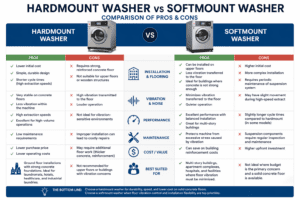
Here’s a quick go to table to determine which type of machine will suit your needs:
What is the difference between a hardmount and sofmount washer extractor?
-
Hardmount washer-extractors are bolted directly to a reinforced concrete floor. They’re rugged, cost-effective, and common in high-volume laundry facilities.
-
Softmount washer-extractors have built-in suspension systems that absorb vibration, allowing them to be installed on a variety of flooring types without needing thick concrete reinforcement.
Which type is more affordable?
Hardmount washers are generally less expensive to purchase than softmount models. However, installation costs can rise if the floor requires reinforcement or plumbing relocation. Softmounts cost more upfront but can save money on installation in buildings without reinforced concrete.
Which type is better for space and flexibility?
Softmount washers are more flexible. They can be installed on upper floors, in smaller spaces, or in buildings where major construction isn’t possible. Hardmounts require a solid ground-floor installation with thick concrete.
How do performane and efficiency compare?
Both types offer high extraction speeds and efficiency, but softmount washers typically allow higher spin speeds. This removes more water from textiles, cutting dryer time and saving on energy costs. Hardmounts are very durable, but may not achieve the same water extraction levels.
Which type is best for my business?
-
Choose a Hardmount if:
-
You have a reinforced concrete floor.
-
You want the lowest upfront equipment cost.
-
Your operation is ground-floor and high-volume.
-
-
Choose a Softmount if:
-
You need installation on upper floors or non-concrete surfaces.
-
You want maximum energy efficiency and faster throughput.
-
You prefer flexibility for future layout changes or expansions.
-
What happens if I choose the wrong type of washer extractor?
Choosing the wrong washer-extractor can lead to costly issues: cracked floors, machine vibration, expensive retrofitting, or excessive energy use. That’s why it’s best to consult with a commercial laundry expert before buying.
Why is it important to properly plan a commercial laundry facility?
Proper planning saves time, money, and frustration. Without it, businesses risk costly mistakes such as incompatible equipment, plumbing conflicts, or poor workflow. Even experienced architects and contractors find on-premise laundry design challenging, so a planning guide helps ensure the facility is efficient, compliant, and operational on time and budget.
Where is the best location for a commercial laundry room?
Ground floor locations are ideal. Commercial washers and dryers can weigh hundreds of pounds, making basement or elevator access difficult. The site should also include an external wall for dryer exhausts and air intakes, reducing the need for expensive ductwork.
How much space is required for a commercial laundry room?
The required space depends on load volume and equipment size. Plan for the machines to have enough room behind them to get serviced and allow for piping and drainage, PLUS enough room for the doors to open on the machines and allow laundry carts to pass while they are open. Plus, think about creating enough room to move carts, sort laundry, and allow staff to work safely. A good rule is to design for future growth, leaving extra room for added machines.
What type of equipment is essential?
At minimum, you’ll need commercial washers, dryers, and sorting tables. Larger operations may require flatwork ironers, folding machines, and ozone or oxidation systems for sanitization. Choose energy-efficient equipment to reduce long-term operating costs.
What flooring requirements should I consider?
Flooring depends on the type of washer-extractors you choose:
-
Hard-mount washers must be bolted into reinforced concrete.
-
Soft-mount washers have more flexible flooring requirements.
Plan your flooring and plumbing layout after selecting your machines to avoid drilling into pipes when bolting equipment down. Avoid timber floors and underfloor heating beneath heavy-duty machines. If alternatives are necessary, consult a structural engineer and consider installing a concrete plinth.
How do I choose the right machines for my laundry?
Machine selection affects space, efficiency, costs, and maintenance. Before purchasing, consider:
- Volume of laundry being done daily. Haddon experts can help you figure this out!
-
Door widths for moving machines and carts in and out.
-
Adequate room in front of and behind machines for staff, technicians, and chemical storage.
-
Workspace needs for folding, sorting, and handling laundry.
-
Compatibility with your utilities (electrical, water, exhaust).
What utility requirements are essential?
-
Electrical: Commercial washers and ironers typically require three-phase power; dryers may use single or three-phase. Ensure your electrical system matches your chosen machines.
-
Water: Check flow and pressure. Some washers lack built-in air gaps, requiring separate backflow prevention.
-
Exhaust & Air Inlets: Dryers need properly sized exhaust ducts and air inlets. Gas dryers should vent outdoors, and boiler flues must terminate safely. In colder climates (like BC), install make-up air vents with automatic closures to prevent frozen pipes.
How should the laundry room layout be organized?
-
Separate soiled/in and clean/out doors for hygiene and workflow, if possible.
-
Allocate about one-third of the space for washing and two-thirds for drying, ironing, sorting, and storage.
-
Ensure at least one fire exit also doubles as a machine access route with wide-enough doors.
-
Consider space for advanced sanitization systems, such as the Lux UV laundry system.
